 Grey Folio
Sikhye is already on the menu at some of Seoul’s best bars. It appears in cocktail programs, in drink competition builds, and in the growing vocabulary of Korean ingredient-forward drink design. And yet, for most bartenders working outside Korea, sikhye remains either entirely unknown or vaguely familiar — the sweet rice drink in a can at the Korean grocery store, somewhere near the barley tea.
That positioning — dessert drink, novelty, canned product — undersells what sikhye actually is as a bar ingredient. It is, among other things, a naturally sweetened malt liquid produced by enzymatic conversion of rice starch. It behaves differently from sugar syrup, differently from honey water, and differently from any other sweetener in the standard bar pantry. Understanding why is the starting point for using it.
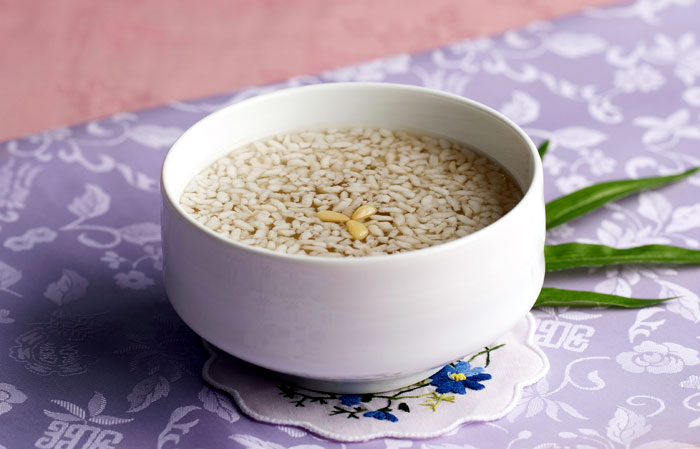
What Sikhye Actually Is
Sikhye (식혜) is a traditional Korean rice beverage made from three ingredients: cooked short-grain rice, malted barley (yeotgireum, 엿기름), and water. Its origins trace to at least the Three Kingdoms period (57 BCE–668 CE), and it has been served in royal courts, at ceremonial feasts, and as an after-meal digestif throughout Korean culinary history.
The drink is non-alcoholic. This is worth establishing clearly, because sikhye is often described as “fermented” — and the word carries connotations that don’t apply here. What happens in sikhye production is enzymatic saccharification, not microbial fermentation. No yeast. No alcohol. The process is closer to what happens in a brewery’s mash tun than to what happens in a fermentation vessel. The result, when made correctly: a clear-to-amber liquid with soft malt character, gentle sweetness, and a clean grain finish. Served cold, traditionally garnished with floating rice grains and pine nuts.
The Science: Saccharification, Not Fermentation
The distinction matters practically, not just terminologically.
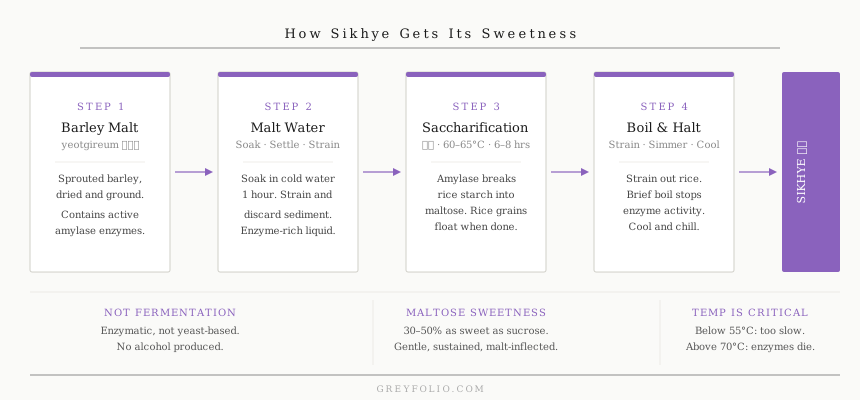
Barley malt contains amylase enzymes — alpha-amylase and beta-amylase — that activate in warm water. When malt water is combined with cooked rice at approximately 60–65°C and held at that temperature for 4–8 hours, the enzymes break down the long starch chains in the rice into shorter sugar molecules, primarily maltose.
Maltose is the key compound. It is approximately 30–50% as sweet as table sugar, which explains sikhye’s characteristic sweetness — present but not aggressive, longer-lasting than a sugar hit, with a malt-inflected depth. The sweetness reads as earned rather than added.
Temperature control is non-negotiable. Below 55°C, enzyme activity is too slow. Above 70°C, the enzymes denature and conversion stops entirely. The traditional method — warming sikhye in an ondol-heated room overnight — worked precisely because ondol maintained the right temperature range passively. The modern rice cooker’s “keep warm” setting replicates this almost exactly.
The signal that saccharification is complete: 3–7 rice grains floating to the surface. The starch inside them has been converted; the remaining shell is lighter than the surrounding liquid. It is one of the more elegant readiness indicators in traditional Korean food production.
Sikhye vs. The Sweetener Vocabulary Bartenders Already Have
The most useful frame for a bartender encountering sikhye for the first time: think of it as a sweetener with personality, not a beverage to pour straight.
vs. Simple syrup — sikhye provides sweetness with a malt backbone, grain character, and a clean, slightly earthy finish. It doesn’t function as a neutral sweetener; it carries flavor. That flavor is additive rather than transparent.
vs. Honey syrup — honey carries floral and waxy notes that compete with delicate spirits. Sikhye’s malt character is quieter, more background. It supports rather than leads.
vs. Orgeat — the closest structural parallel. Orgeat is a sweetener with a strong flavor identity that shapes the entire character of a build. Sikhye occupies a similar role — functional sweetener that also contributes flavor — but its profile is malt-grain rather than nut-floral. Considerably more versatile.
vs. Japanese amazake — amazake is produced using koji (Aspergillus oryzae) rather than barley malt, and tends toward a thicker, funkier result. Sikhye is cleaner and more grain-forward. The comparison comes up often in conversations about Korean drink design; the distinction is worth knowing.
A Note on Gamju — and How Confusing a Name Can Get
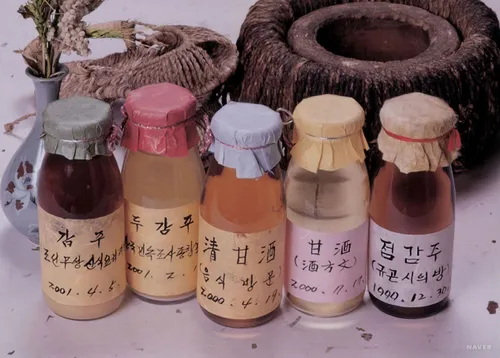
Sikhye has another name. Dansul — sweet liquor. And gamju (甘酒) — which translates directly as “sweet wine.”
Sweet wine. Except sikhye is not wine. And not alcoholic.
This is not a translation error. There are actually two distinct drinks tangled up in the same name, and the confusion has been running for centuries.
The first is sikhye as described above — barley malt enzymatic saccharification, no alcohol, clean grain sweetness. According to Korean food records, the distinction between sikhye and gamju was sometimes as simple as this: with floating rice grains, it’s called sikhye; without, it’s called gamju. Same liquid, different serving convention, different name.
Then there is the other gamju. The one that actually contains alcohol.
Alcoholic gamju is a rice drink fermented with nuruk — microbial fermentation, not enzymatic conversion. It is, in essence, makgeolli that was stopped before fermentation completed. Low alcohol content, opaque, slightly sweet with a faint lactic tartness. If makgeolli is the finished work, alcoholic gamju is the draft.
These two drinks share a name. One is non-alcoholic. One is alcoholic. The drink called “sweet wine” in one version contains no wine at all.
Royal court records from the Joseon Dynasty note sikhye — or gamju — served at the end of ceremonial feasts as a digestif. Whether the version poured was alcoholic or not, the records do not always specify. The court historians recorded that it was served. They did not always record which one. That ambiguity may be the oldest surviving evidence of this naming problem.
For the Drink Designer: A Practical Comparison
| Sikhye | Gamju (alcoholic) | |
|---|---|---|
| Process | Enzymatic saccharification | Microbial fermentation (nuruk) |
| Alcohol | None | Low (approx. 1–3%) |
| Appearance | Clear to amber | Opaque, cloudy |
| Sweetness | Malt-based, long, quiet | Fermented sweetness, faintly tart finish |
| Texture | Light | Similar to makgeolli, slight body |
| Closest Western analogue | Malt extract diluted in water | Unfinished rice beer |
| Bar application | Sweetener, base, non-alcoholic option | Low-ABV base, fermented grain layering |
The Practical Note
Alcoholic gamju is rarely used in Seoul’s current bar scene — harder to source than sikhye, and largely inaccessible without making it yourself. But as an ingredient, it occupies an interesting space: more complex than sikhye, lighter than makgeolli, carrying fermented grain depth without the weight. Worth exploring for builds that want fermentation character without committing to makgeolli’s full body and funk.
And if you plan to write “gamju” on a menu: specify which one. Whether a guest is expecting alcohol or not is a fairly important distinction.
Forms and Preparations for Bar Use
Sikhye liquid — the base drink itself, strained and cold. Used as a sweetener, a lengthener, or a partial base. Sweetness and malt intensity vary by preparation. Commercial canned versions (Paldo, Vilac) are accessible and consistent; homemade yields more intensity and control.
Sikhye reduction — gently reducing sikhye concentrates sugar and deepens malt character. The result is a sikhye syrup usable at 1:1 or 2:1 ratios in builds where concentrated malt sweetness is needed. A direct substitute for simple syrup in grain-forward applications.
Sikhye with ginger — the traditional preparation often includes ginger in the final boil, adding warmth and spice that complement the malt base. A ginger-sikhye syrup is a ready-made flavored sweetener requiring no additional build complexity.
Sikhye as a non-alcoholic base — lengthened with soda water, it becomes a standalone non-alcoholic drink with genuine complexity. The malt character and lightness produce something considerably more interesting than soda-and-juice constructions.
Behind the Bar: Who’s Already Working With It
At OUL Bar inside the Four Seasons Seoul, head bartender Ike Ryu has placed sikhye directly on the menu — a cocktail built from craft soju, pumpkin cordial, clarified milk, and chai tea, with sikhye as the sweetening foundation. The combination works because sikhye’s malt-grain character integrates with soju’s clean grain base rather than competing with it. The pumpkin and chai add warmth and spice on top of that shared grain foundation.
OUL’s menu frames Korean ingredients as functional selections, not cultural decoration. Sikhye appears there because it solves a specific problem — sweetening with character — more precisely than neutral alternatives.
Flavor Pairing Logic
Distilled soju — the most direct pairing. Sikhye’s malt-grain sweetness and soju’s clean grain finish speak the same language. Neither competes. The combination reads as integrated rather than assembled.
Light whisky — Japanese or Irish expressions, not heavily peated or high-oak. Sikhye’s malt character resonates with whisky’s own malt foundation; a sikhye-sweetened whisky highball produces a more layered result than one sweetened with simple syrup.
Makgeolli — sikhye and makgeolli share a grain origin. Used together — sikhye as sweetener in a makgeolli-based build — they create layered grain depth without sweetness becoming one-dimensional.
Cold brew coffee — the malt character of sikhye and the roasted depth of coffee have natural affinity. A cold brew sweetened with sikhye reduction reads as more complex than one sweetened with sugar; the grain-and-roast layering is worth exploring.
Avoid — heavily aromatic spirits where sikhye’s malt contribution reads as competing rather than complementary. Heavily floral gin, overproof rum, intensely peated Scotch. Sikhye’s presence is subtle; it needs space.
A Practical Starting Point
The simplest bar application: replace simple syrup with sikhye reduction in a whisky highball or distilled soju build. Reduce commercial or homemade sikhye by a third over low heat, cool, and store refrigerated. Use at the same ratio as your usual sweetener — note that sikhye is less sweet than 1:1 simple syrup, so adjust accordingly.
For homemade: 100g malted barley powder in 1L cold water, soaked 1 hour and strained. Combine clear malt water with 200g cooked short-grain rice in a rice cooker on “keep warm” for 6–8 hours. When 3–7 grains float, saccharification is complete. Strain, bring briefly to a boil to halt enzyme activity, cool, and refrigerate. Shelf life: 3–5 days.
Commercial versions are an adequate starting point. The flavor difference between commercial and homemade is real — homemade carries more malt intensity — but the commercial product is consistent and immediately accessible for a first test in a build.
Sikhye is not yet a standard ingredient in bars outside Korea. That is the reason to work with it now.
Related: Makgeolli, Reconsidered — Nuruk: The Fermentation Engine — Omija: The Korean Berry Bartenders Need to Know