 Grey Folio
Perilla is already on the menus of Seoul’s most serious bars. It appears alongside omija, yuja, and fermented grains in the vocabulary of Korean ingredient-forward drink design. Outside Korea, it occasionally shows up as a garnish — slapped between the palms, placed on the rim, used as a visual signal of Asian influence. That’s not the same thing as using it.
The herb that Koreans wrap their grilled pork in, pickle in soy sauce, and reach for instinctively at the table has a flavor profile that bartenders have barely begun to map. This note is about what it actually is, how it differs from every herb already in the bar pantry, and what it can do in a build.
What Perilla Actually Is
Perilla (Perilla frutescens) is an annual herb in the mint family, native to Asia and cultivated across Korea, Japan, and China for centuries. In Korean it’s called kkaennip (깻잎) — literally “wild sesame leaf,” a name that reflects historical linguistic overlap with sesame rather than any botanical relationship. The two plants are unrelated.
There are two main varieties that matter for a bartender. Perilla frutescens var. frutescens is Korean perilla — large, flat, broad leaves, green on top with occasional purple on the underside, strong and assertive in flavor. Perilla frutescens var. crispa is Japanese shiso — smaller, crinkled, more delicate in both structure and flavor. They come from the same species but behave differently in a glass. The distinction matters, and it’s worth establishing clearly before going further.
Korean kkaennip is not a substitute for shiso. It is a different ingredient.
The Flavor Profile: What Makes It Different
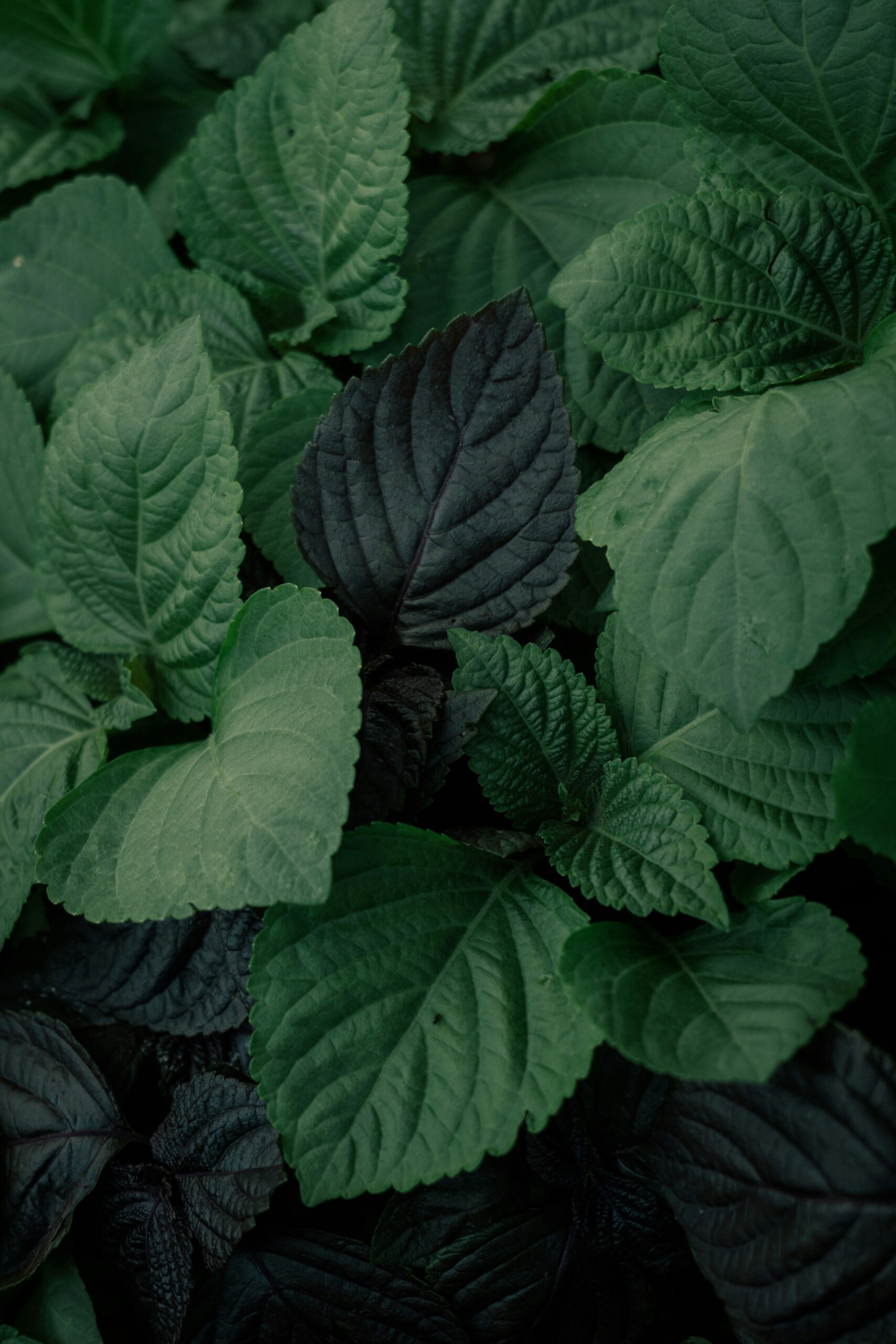
The dominant volatile compound in cultivated Korean perilla is perilla ketone — present at approximately 87% of total volatile content in the green-leafed variety. This is the compound responsible for kkaennip’s characteristic aroma: earthy, warm, slightly camphoraceous, with a depth that sits nowhere near mint’s clean menthol or basil’s sweet Mediterranean register.
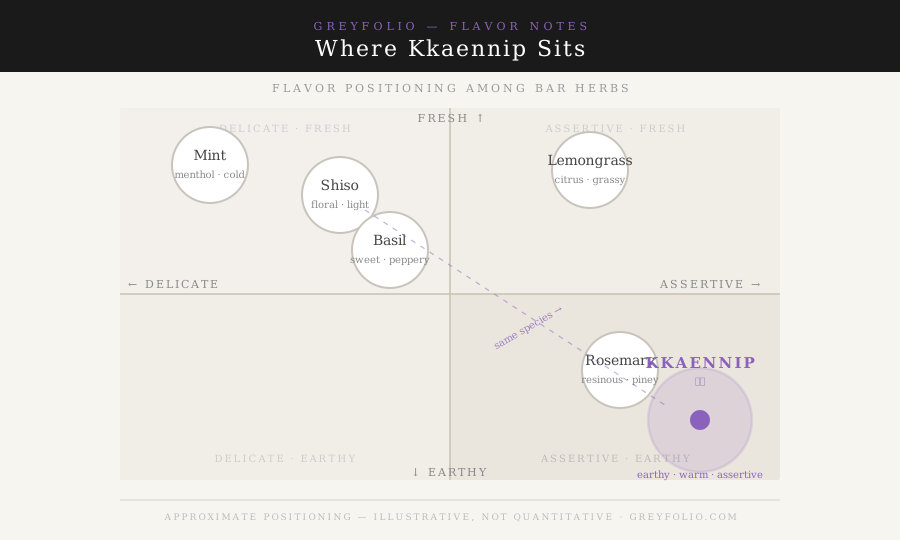
Secondary compounds — β-caryophyllene, limonene, rosmarinic acid — contribute complexity. The result in practice is a flavor profile that combines elements of anise, fresh greenness, a faint bitterness, and an earthy warmth that lingers. It is herbal in a way that is categorically different from any herb already common in the Western bar pantry.
The most common description — “somewhere between mint and basil” — is accurate as a starting point but misleading as an endpoint. Mint has a single dominant flavor vector: menthol, cold, clean. Basil has another: sweet, peppery, Mediterranean. Perilla doesn’t sit between them; it occupies entirely different territory. The anise quality is real but not dominant. The bitterness is present but not aggressive. The earthiness is what stays.
One practical consequence: perilla’s aroma is more sustained than mint’s. Mint’s menthol hits immediately and dissipates relatively quickly. Perilla’s volatile compounds are more persistent — they linger in the glass and on the palate. This changes how you use it.
Kkaennip vs. Shiso: The Distinction That Matters
The comparison comes up constantly because shiso arrived in Western culinary culture first, carried by Japanese cuisine’s global spread. It appeared on sushi plates, in ponzu sauces, on omakase menus. When Korean food and Korean bars began attracting international attention, Western bartenders reached for shiso as a reference point — not because the two herbs are the same, but because shiso was already in the vocabulary.
That’s the source of the confusion. And it has practical consequences.
Both kkaennip and shiso are Perilla frutescens. Both are in the mint family. Both can be slapped between the palms before use as a garnish. The botanical relationship is real. The flavor relationship is not.
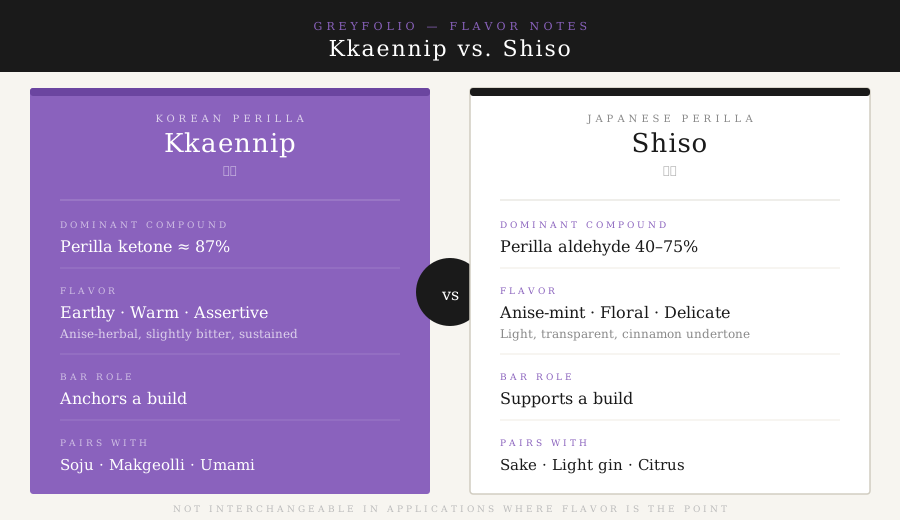
The chemistry explains the difference. Korean perilla’s dominant volatile compound is perilla ketone, present at approximately 87% of total volatile content in the cultivated green-leafed variety. Shiso’s dominant compound is perilla aldehyde. Different compounds, different flavor profiles — not different intensities of the same thing, but categorically different aromatic registers.
In the glass, shiso reads as lighter, more floral, closer to cinnamon-basil with a delicate herbal lift. It’s transparent: it adds an aromatic layer without announcing itself. Kkaennip reads as earthier, warmer, more assertive. It has presence. Where shiso whispers, kkaennip speaks.
For drink design, the practical difference:
| Kkaennip 깻잎 | Shiso 시소 | |
|---|---|---|
| Dominant compound | Perilla ketone | Perilla aldehyde |
| Flavor register | Earthy, warm, anise-herbal | Floral, light, cinnamon-basil |
| Intensity | Assertive | Delicate |
| Best use | Primary aromatic element, syrup, infusion | Garnish, aromatic accent |
| Pairs with | Grain spirits, makgeolli, umami | Sake, light gin, citrus |
| Heat tolerance | Moderate | Low — dissipates quickly |
| Western availability | Korean grocery stores | Japanese grocery stores, wider distribution |
Where shiso works better: builds where you want herbal fragrance without weight — a light gin fizz, a sake-based drink, anything where delicacy is the point. Shiso’s transparency makes it a natural pairing with Japanese spirits and light preparations. It enhances without competing.
Where kkaennip works better: builds where the herb is meant to anchor, not accent. Grain-forward Korean spirits, umami-adjacent builds, anything where you want herbal character that holds its own against strong flavors. Kkaennip can carry a build; shiso supports one.
The substitution question: they are not interchangeable in applications where flavor is the point. They can substitute for each other visually. They cannot substitute for each other aromatically. Using shiso where kkaennip is called for produces a drink that is lighter and more floral where it should be earthier and more complex — not wrong, exactly, but not the intended result.
One further note: shiso is significantly more available in Western markets than kkaennip. Japanese grocery stores and many specialty food shops carry it. Korean grocery stores are the reliable source for kkaennip. If access is the constraint, shiso is an approximation — but it should be understood as an approximation, not an equivalent.
Forms and Preparations for Bar Use
Fresh kkaennip — slap technique — the standard bar application. Place one or two leaves in the palm, slap firmly with the other hand to bruise the surface and release volatile compounds. Use immediately as a garnish over the glass. The aroma bloom is brief but intense; the point is nose, not flavor. This is how mint is commonly used, and the parallel technique works for the same reason.
Kkaennip syrup — cold infusion of fresh leaves in simple syrup (1:1 sugar to water), steeped 4–8 hours at room temperature, then strained. The result carries perilla’s earthy-anise character in a sweetened liquid. Use as you would an herb syrup — in builds where botanical sweetness is needed. Unlike mint syrup, which reads as clean and refreshing, kkaennip syrup reads as more complex and slightly savory. The combination with citrus acid is particularly effective.
Kkaennip-infused spirit — fresh leaves cold-infused in a neutral or grain-forward spirit (distilled soju, vodka, light whisky) for 24–48 hours at room temperature. Perilla’s volatile compounds extract efficiently into alcohol. The resulting infusion carries the herb’s character without the visual weight of the leaf. Useful for builds where clarity is needed.
Kkaennip jangajji (pickled perilla) — soy sauce-marinated perilla leaves, a standard Korean banchan. The pickling transforms the fresh herb’s flavor significantly: the volatile brightness fades, the savory umami of soy comes forward, and the result is deeply flavored rather than aromatically fresh. Primarily a culinary preparation, but worth understanding as a reference for what transformation does to the ingredient.
Kkaennip oil — perilla seed oil, pressed from the seeds of the same plant. A different ingredient with a different application — nutty, rich, with none of the leafy aromatics of kkaennip. Used in Korean cooking as a finishing oil. Behind the bar, it has applications in fat-washing and as a flavor component in savory or umami-forward builds. Discussed separately because it behaves nothing like the leaf.
Behind the Bar: Who’s Already Working With It
Seoul’s bar scene has been working with kkaennip for several years. In the vocabulary of Korean ingredient-forward cocktail design — documented across Bar Cham’s menu approach, OUL’s seasonal ingredient program, and the broader movement of bars using Korean botanicals as foundational rather than decorative elements — perilla appears consistently alongside omija, yuja, mugwort, and fermented grains.
Bar Cham, which appeared on Asia’s 50 Best Bars 2025, uses kkaennip as part of its approach to stacking Korean botanical complexity. The herb functions in builds not as the featured ingredient but as a layer within a larger flavor architecture — contributing earthiness and herbal depth to builds where other Korean ingredients provide acidity and sweetness.
Outside Korea, kkaennip has appeared occasionally in cocktail contexts — mojito riffs, julep variations using the slap-garnish technique — but the applications have been largely surface-level. Using perilla as a mint substitute is the beginning of engagement with the ingredient, not the destination.
Flavor Pairing Logic
Distilled soju — the most direct pairing. Kkaennip’s earthy-herbal character sits comfortably alongside soju’s clean grain base. Neither competes; both read as Korean. The combination has cultural and flavor logic simultaneously.
Gin — botanical gins with earthy or herbal profiles integrate better than heavily floral ones. The right gin makes kkaennip feel like a natural extension of the botanical bill. Heavily juniper-forward expressions can clash with perilla’s own assertiveness.
Makgeolli — perilla and makgeolli share a frequency. The lactic acidity of makgeolli and the earthy warmth of kkaennip create complementary depth rather than competing layers. A kkaennip-infused makgeolli build is one of the more logical Korean ingredient pairings.
Citrus — kkaennip’s bitterness and earthiness sharpen against citrus acidity. Yuja in particular: the two ingredients are culturally paired (yuja-cheong is sometimes garnished with perilla), and the flavor logic holds in a glass. The combination produces a brightness-depth contrast that neither achieves alone.
Umami ingredients — kkaennip has a savory register that works in umami-adjacent builds. Doenjang, ganjang, mushroom, seaweed — perilla’s earthiness moves comfortably in this territory in a way that mint or basil would not.
Avoid — heavily peated Scotch, where smoke overwhelms perilla’s subtler earth notes. High-sugar builds where sweetness flattens the herb’s complexity. And excessive heat — perilla’s volatile compounds are moderately temperature-sensitive; hot preparations reduce aromatic presence significantly.
A Practical Starting Point
The lowest-commitment entry point: add a slapped kkaennip leaf as a garnish to a distilled soju highball or a Korean grain spirit build. The investment is one leaf and five seconds. The aromatic contribution is immediate and distinctive. It’s a fast way to understand what the ingredient does before committing to a syrup or infusion.
The next step: a kkaennip syrup. Cold-steep 20g fresh leaves in 250ml 1:1 simple syrup for 6 hours at room temperature. Strain. The syrup keeps refrigerated for up to one week — perilla oxidizes relatively quickly, and the syrup will darken. Use before it does. Replace mint syrup with kkaennip syrup in a gin sour or a soju-citrus build and note what changes: the clean menthol register becomes earthier, more complex, slightly savory. That shift is the ingredient’s value.
Fresh kkaennip is available year-round at Korean grocery stores globally — it’s a staple ingredient, not a seasonal one. The barrier to working with it is access to a Korean market, not a specialized import. For most bartenders, that barrier is lower than they assume.
Kkaennip is not yet a standard ingredient in bars outside Korea. That is the reason to work with it now.
Related: Omija: The Korean Berry Bartenders Need to Know — Yuzu vs. Yuja — Sikhye: The Korean Fermented Grain Drink Bartenders Need to Know