 Grey Folio
Soju is the world’s best-selling spirit by volume. That fact surprises most people outside Korea — and reveals something important about how little the international drinks world has engaged with it on its own terms.
For decades, soju’s global image was fixed: a small green bottle, cheap, consumed as shots, a vehicle for getting through long nights rather than something to taste. That image was accurate for a specific product category — diluted soju, the industrial kind, soft and neutral at 16–25% ABV. But it was never the whole picture. And increasingly, it isn’t even the dominant one.
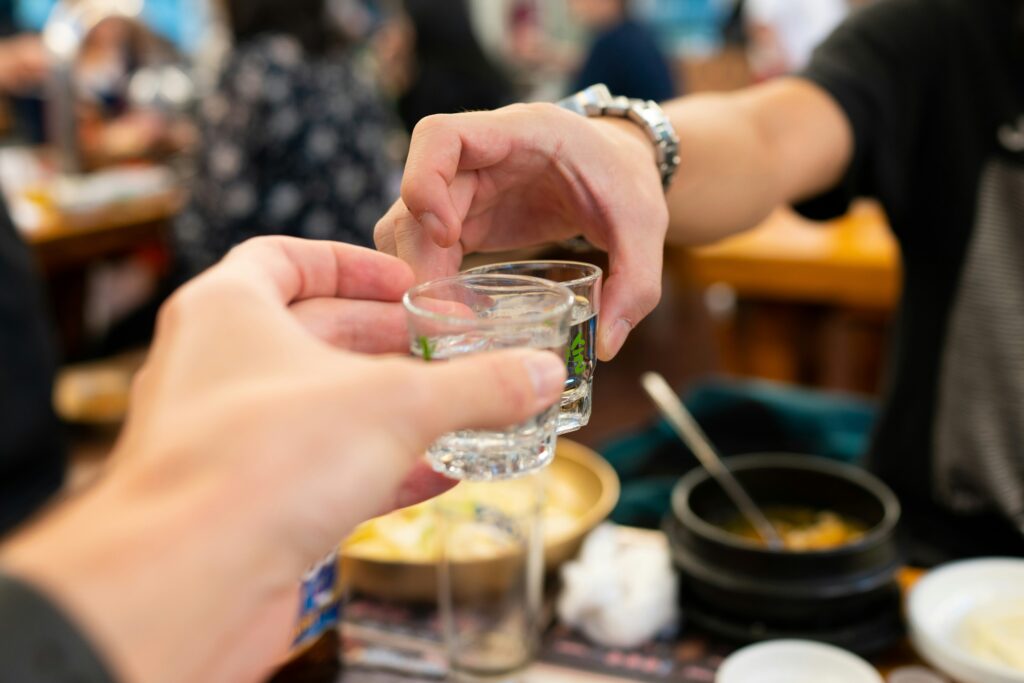
Two Sojus, Two Conversations
The first thing a beverage creative needs to understand is that “soju” describes two fundamentally different things.
Diluted soju is what most of the world knows. Made from diluted neutral spirit (often sweet potato or tapioca base), it’s clean, soft, and intentionally unobtrusive. Think of it as Korea’s answer to vodka — but lower ABV, slightly sweet, and designed to accompany food rather than compete with it. Jinro Chamisul is the category leader. It’s a tool for blending, not sipping.
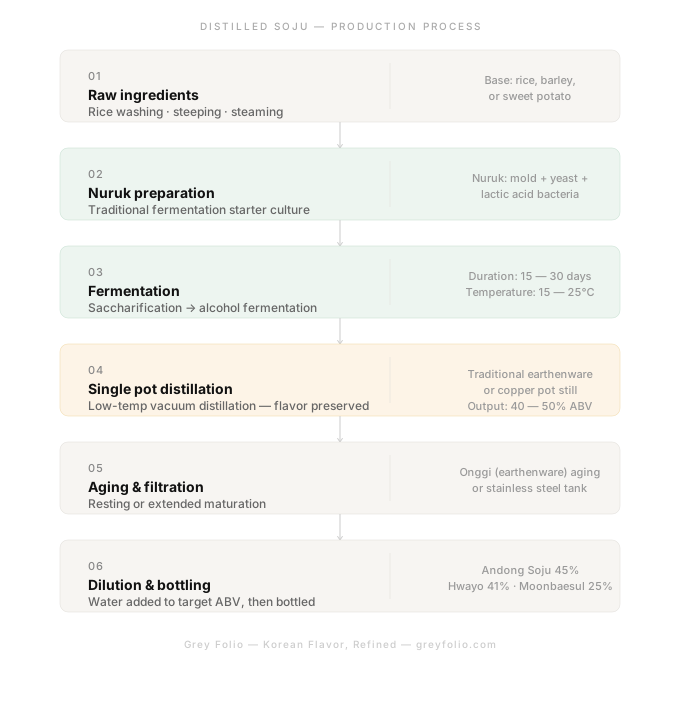
Distilled soju is the conversation that matters more for serious drink work. These are pot-distilled spirits made from single ingredients — rice, barley, sweet potato — and aged or rested to develop character. Andong Soju (rice, 45% ABV) is the most historically significant: a Joseon Dynasty recipe, clear and dry, with a faintly grainy depth that sits closer to unaged Chinese baijiu or Japanese shochu than anything European. Hwayo 41 is cleaner, polished, with a round mouthfeel. Moonbaesul, distilled from millet, rice, and sorghum in the royal court tradition, carries a floral aromatic lift — its name refers not to pears as an ingredient, but to the wild Korean pear (munbae) fragrance that naturally emerges from fermentation.
These are not the same drink. Treating them as interchangeable is the equivalent of writing “whisky” without distinguishing Scotch from bourbon.
Flavor Architecture
At its best, distilled soju operates in a flavor space that’s genuinely distinctive.
Grain-forward, not malt-forward. Rice-based soju has a cleaner, lighter grain character than barley spirits. There’s sweetness in the fermentation, but it’s restrained — more steamed rice than bread. Sweet potato soju adds an earthy, faintly vegetal richness that reads as weight without heaviness.
Fermentation character without funk. The use of nuruk — Korea’s traditional fermentation starter — introduces lactic and organic acid complexity during production. In the finished spirit, this reads as a subtle brightness, a slight savory undertone, without the pronounced funk of koji-forward Japanese spirits.
Dry finish, long. Well-made distilled soju finishes clean and long. The absence of residual sweetness is what makes it food-compatible in a way that most Western spirits struggle to match.
Why It Matters for Drink Design
Soju’s low-to-mid ABV (35–45% for good distilled soju) means it reads differently in a glass than a 50% whisky or gin. Flavor comes through more readily in shorter drinks, and dilution in longer ones needs recalibrating.
It amplifies acidity. Pair soju with citrus and the combination is cleaner, brighter, more transparent than equivalent builds with vodka or gin. Yuja and distilled rice soju is one of the most natural pairings in Korean flavor.
It loves fermented flavor. A doenjang rinse or a small dasida wash in a savory build doesn’t clash — it resonates. The lactic notes in the spirit and the lactic notes in the ferment speak the same language.
It works as a lengthener. A small measure of diluted soju in a carbonated long drink adds body and clean sweetness without the sugar load of a liqueur — underutilized in modern drink design outside Korea.
It doesn’t compete with delicate flavors. Floral, herbal, subtle — soju won’t bulldoze them. Perilla, omija, chrysanthemum all work in builds where a more aromatic spirit would overwhelm.
Three Starting Points
Andong Soju (45% ABV, rice) — The historical benchmark. Dry, clean, faintly grainy. Use as a base where you’d reach for a lightly aged spirit.
Hwayo 41 (41% ABV, rice) — More polished, rounder mouthfeel. Works well in shorter drinks where texture matters.
Moonbaesul (25% ABV, pear/rice) — Aromatic, delicate, floral. Excellent as a modifier or in layered builds.
Anju: The Table That Comes With the Drink
In Korea, soju is never drunk alone. The concept of anju (안주) explains everything. More than just bar snacks, anju is the cultural grammar that structures the entire drinking experience. In Korea, a drinking session is a meal, and a meal is a conversation.
Drinking without food is almost unheard of. Anju reduces the burden of alcohol, makes the experience more enjoyable, and the act of sharing food around the table creates warmth that the drink alone cannot. It sets the pace, the tone, and the duration of the night.
The foods that pair best with soju tend to be heavy and fatty. Grilled pork belly — samgyeopsal — is the canonical pairing. Soju’s dry, clean finish acts as a palate reset after each fatty bite, preparing the mouth for the next one. The logic is physiological as much as it is cultural. After a piece of samgyeopsal, a shot of soju doesn’t feel like a break from the food. It feels like part of the same sentence.
Seafood is another long-standing partner. Just as the Japanese pair sake with sashimi, Koreans frequently pair soju with raw fish (hoe). The spirit’s clean profile neutralizes fishiness and cuts through richness without overwhelming the delicacy of the fish itself.
Hot stews round out the picture. Kimchi-jjigae, gamja-tang, jogae-tang — spicy, deeply savory soups consumed alongside soju are the archetypal Korean drinking table. The heat of the stew absorbs the alcohol’s edge; the soju cuts through the richness of the broth. Neither dominates. Both make the other better.
Dried shredded squid — ojingeo — deserves a mention of its own. Salty, intensely chewy, almost more tactile than flavor-driven, it’s designed for the kind of table where the conversation is more important than the food. The chewing slows everything down. That slowness is the point.
What connects all of these pairings is a shared principle: soju doesn’t fight the food. It moves alongside it — cleaning, resetting, punctuating. That quality, more than any flavor characteristic, is what makes it the default spirit of the Korean table.
Soju in the West: What’s Already Happening
Soju’s entry into Western bar culture has been quiet but deliberate — and the results are worth paying attention to.
In New York’s Lower East Side, Reception Bar runs an entirely soju-based cocktail program. The Martini 100 is built with Baekseju, a Korean ginseng-infused rice wine. Smokes replaces bourbon with pine-smoked lapsang soju in an Old Fashioned framework. Ginger Goblin, made with premium Hwayo soju, functions as a Korean counterpart to a Mezcal Mule. Yuja 88 pairs juniper soju with sparkling chrysanthemum, yuja honey, and lemon. Orchard St builds on osmanthus soju with grapefruit, Korean pear shrub, and salt.
The approach is consistent across these builds: take a Western cocktail framework, substitute soju for the base spirit, and introduce Korean botanicals and acids to create something that couldn’t exist without both traditions. The result isn’t fusion for its own sake — it’s a genuine expansion of what soju can do when treated as a craft ingredient rather than a commodity.
London is moving in the same direction. Hongdae Pocha in Soho has brought Korean drinking culture to the heart of the city, centering its drinks program on soju cocktails and highballs alongside traditional Korean rice wines. The intention, as the owner describes it, is to offer “a glimpse of Korea through food, drinks, and above all, atmosphere.”
What these bars are doing matters beyond their individual menus. They are establishing a vocabulary — demonstrating that soju can anchor a serious cocktail program, that Korean flavor pairings translate into Western drinking contexts, and that the spirit has enough range to support multiple styles and formats.
That vocabulary is still being written. The bars doing it well are few. The ingredients — the distilled sojus, the Korean botanicals, the fermented modifiers — are increasingly available outside Korea. What’s missing is documentation: a serious, accessible reference for the drink professionals who want to work with these ingredients but don’t know where to start.
That’s the gap Grey Folio exists to fill.
The Gap Worth Filling
The English-language drinks canon has spent decades writing about Japanese whisky, shochu, and baijiu. Distilled soju — the kind with real provenance and flavor — has almost no serious documentation in the Western drinks world. That’s a gap. And for anyone working in Korean food and beverage, it’s also an opening.