 Grey Folio
Makgeolli is having a moment — but not in the way it deserves. Outside Korea, it tends to get filed under “interesting curiosity”: the cloudy, milky Korean rice wine that pairs with pancakes on rainy days. That framing is accurate as far as it goes. It just doesn’t go very far.
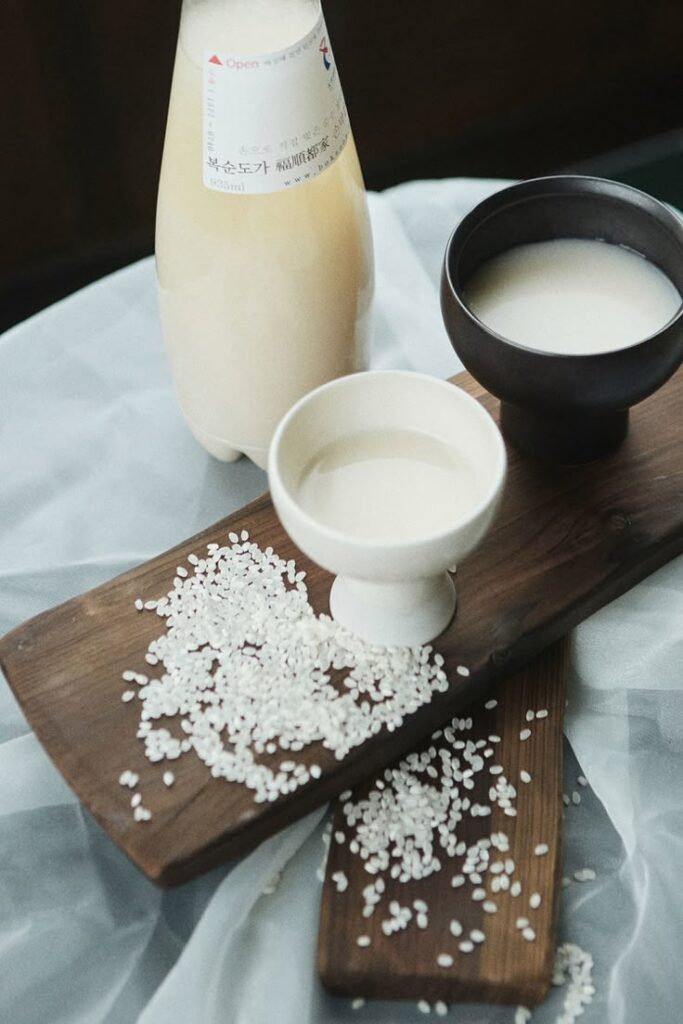
The more useful frame for a beverage creative is this: makgeolli is a live, active ferment with a flavor profile that no other category replicates. Understanding it properly opens up a set of tools — textural, acidic, savory, effervescent — that most Western drink design has barely touched.
What Makgeolli Actually Is
Made by fermenting cooked rice with nuruk — the same traditional Korean fermentation starter used in distilled soju production — makgeolli is unfiltered, unpasteurized in its best forms, and alive. The milky appearance comes from suspended rice solids and active yeast still present in the liquid. It is, in the most literal sense, a drink that continues to change after it leaves the brewery.
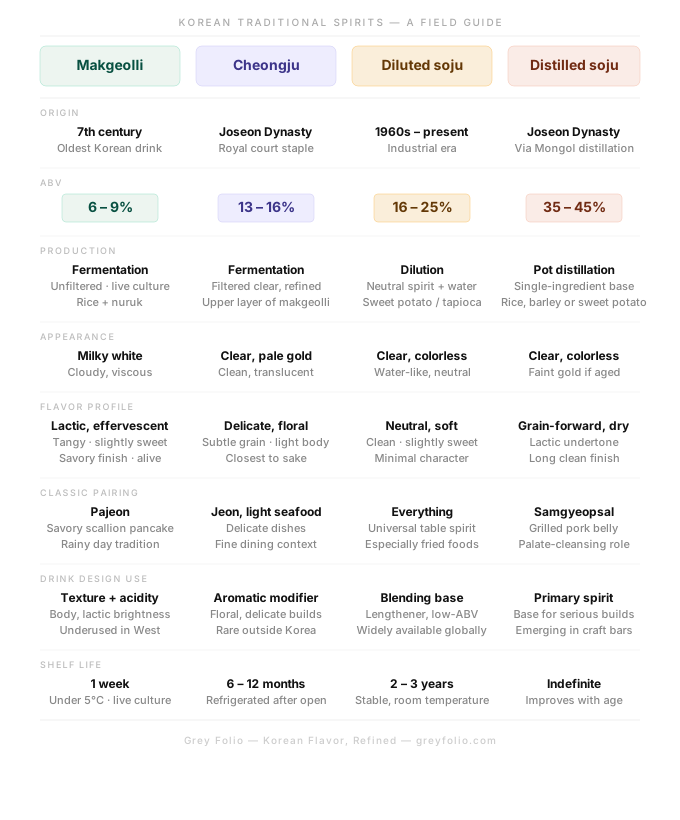
ABV typically sits between 6% and 9%. Lower than wine. Slightly higher than most beer. But the comparison to either misses the point: the flavor architecture is entirely its own.
The fermentation produces lactic acid, acetic acid, and a range of organic compounds that give premium makgeolli its characteristic complexity — a gentle effervescence, a slight tang, a faint sweetness from residual sugars, and an umami undertone that reads almost savory at the finish. Commercial makgeolli flattens most of this with artificial sweeteners and pasteurization. Craft makgeolli — the kind worth paying attention to — does not.
Makgeolli vs. Soju: A Different Fermentation Logic
Where distilled soju takes the fermented mash through distillation to isolate alcohol, makgeolli stops at fermentation. Nothing is removed. The result is closer in concept to a natural wine or an unfiltered sake than to any distilled spirit — but the nuruk-driven fermentation gives it a lactic character that neither wine nor sake produces in the same way.
This distinction matters for drink design. Soju offers a clean, neutral base that amplifies what you add to it. Makgeolli offers texture, acidity, and live ferment complexity — it brings more of itself to the build.
Flavor Profile: What You’re Actually Working With
Premium makgeolli is not one thing. The range is significant:
Traditional rice makgeolli — the baseline. Light effervescence, gentle sweetness, lactic brightness, clean grain on the finish. The best examples (Jiranjigyo, Slow Village) are startlingly refined.
Wheat makgeolli — rounder, slightly more bread-like. Less bright on the acid. Closer to a hefeweizen in mouthfeel without the hop character.
Fruit and botanical expressions — a growing category. Fig, chamomile, mugwort, omija. These work when the added ingredient genuinely contributes to the fermentation rather than being stirred in post. The best ones are entirely new flavor objects.
Aged makgeolli — rare, but worth knowing. Extended fermentation or rest develops a sherry-like depth, a more pronounced acetic note, and a texture that approaches cream.
The common thread across all: active acidity, textural weight, and fermented complexity that no other low-ABV ingredient delivers.
Why It Matters for Drink Design
Makgeolli’s low ABV and active fermentation make it behave differently from any spirit or wine in a build. A few working principles:
It is a texture ingredient first. The suspended solids and active yeast give makgeolli a viscosity that reads as weight in the mouth without heaviness. In a long drink, a splash of makgeolli does what cream would do to a Ramos Gin Fizz — it rounds, softens, and adds body — without the fat or the calories.
It carries acidity without aggression. The lactic acid in makgeolli is gentler than citric or tartaric. It brightens a build without the sharp edge of lemon juice. This makes it useful in drinks where you want acidity present but not dominant.
It loves savory. The umami undertone in good makgeolli resonates with fermented ingredients: doenjang, ganjang, even dashi. A savory long drink built around makgeolli and a dashi dilution is a completely underdocumented idea in Western cocktail culture.
It ferments in the glass. Live makgeolli continues to develop after pouring. This is a limitation — it means short shelf life, careful temperature control, and service-side attention — but it’s also an opportunity. The flavor at pouring and the flavor ten minutes later are different. That’s a hospitality moment.
It pairs differently than soju. Where soju cleanses and resets the palate (see: samgyeopsal and soju), makgeolli accompanies and integrates. The classic pairing with pajeon — savory scallion pancake — works because the lactic brightness of makgeolli cuts the oil while the texture holds its own against the pancake’s weight.
Practical Starting Points
Jiranjigyo — a South Korean craft producer that has been exporting to Hong Kong, Singapore, and Paris. Clean, precise, genuinely surprising. The chamomile and fig expressions are reference points for what fruit-infused makgeolli can be when done well.
Slow Village — premium packaging, clean ingredients, accessible flavor. One of the brands credited with shifting perceptions of makgeolli among younger Korean consumers.
Saeng makgeolli (생막걸리) — the category term for unpasteurized, live makgeolli. If you can access it, this is the reference point. Shelf life is roughly one week under 5°C. Handle accordingly.
The Storage Problem — and Why It’s Worth Solving
The main obstacle to makgeolli in serious drink programs is logistics. Unpasteurized makgeolli requires cold storage and has a short shelf life. This is the same challenge that natural wine programs solved over the past decade by treating storage as part of the service proposition rather than a barrier to it.
The bars that figure this out — that treat makgeolli with the same service discipline as a pét-nat — will have access to a flavor category that nobody else on their street is using.
For real-world bar applications using makgeolli — including builds from Zest and OUL Bar — see What Nuruk Actually Does.
Related: Soju, Reconsidered — Nuruk: Korea’s Fermentation Starter — Pajeon & Makgeolli: The Classic Pairing